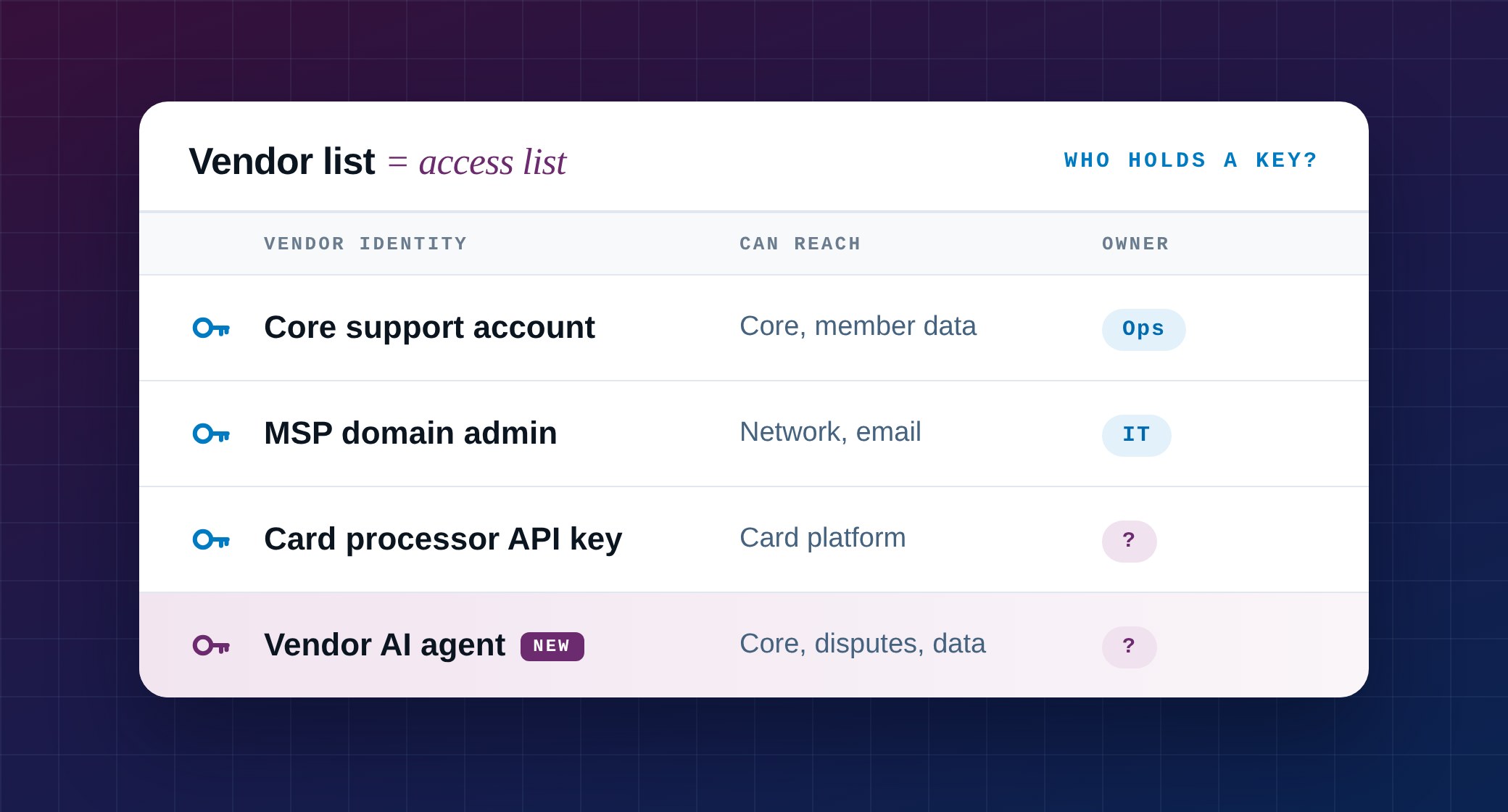
Last month’s issue focused on who has access to your critical systems. This month we’re extending that question to your vendors, including your core provider, your MSP, your card processor and the growing number of AI features built into their products, most of which never appear in an access review.
In this issue you’ll find a look at three regulatory documents from the past two months that bear on vendor access, five questions to bring to your next vendor review, notes from Jack Henry Connect and FIS Horizon, and details on the November 17 live panel about who, and what, has the keys.
What regulators are asking about vendor access
Since September 11, federal regulators have issued three documents that deal with vendor risk, most recently a framework the OCC released on November 4 for how its examiners will evaluate AI, which the federal government now calls “super intelligence.” Although none of the three mentions access reviews by name, each one assumes an institution knows which vendor accounts, integrations and AI features are in its environment, what each can reach and who at the institution is responsible for it. Here’s a quick look at each:
- TPRM proposal. Under the proposal from the OCC, Fed, FDIC and NCUA, the board would decide whether the vendor risk that remains fits its appetite. Comments are due Monday, November 16.
- Core provider statement. When examining community banks, the Fed, FDIC and OCC will consider the core provider’s transparency, contract practices and technology. NCUA did not join this statement.
- OCC super intelligence framework. Written for examiners at national banks and federal savings associations, the framework looks for vendor AI to have a defined scope, advance notice before it changes, and contract terms that let the bank restrict or terminate it.
At most community banks and credit unions, vendor access includes remote support accounts on the core and card platform, the MSP’s administrative rights, the service accounts and API keys behind each integration, and the occasional account left over from a conversion or a contract that has ended. The TPRM proposal asks the board to accept whatever vendor risk remains, which is hard to do in good faith when no one has a complete list of that access.
The list is also growing as vendors add AI to products institutions already use. Jack Henry told investors in August that it had 22 AI-enabled products in market, and FIS has announced an AI agent that gathers evidence across a bank’s core systems. For AI that comes from a vendor, the OCC framework asks how far the provider’s agents can reach into bank systems and data, whether the vendor must give notice before changing models or features, and whether the bank can monitor, test, restrict or terminate them. It also extends identity and access management to agent identities, credentials and logs.
The framework is a resource for OCC examiners and doesn’t create new rules, and it applies only to national banks and federal savings associations. Credit unions and state-chartered banks aren’t covered. Even so, it’s one of the most detailed public statements so far of how a federal examiner thinks about AI that takes actions, and its questions are likely to come up in exams, audits and vendor due diligence well before they appear in any rule. The five questions below put those ideas into a form you can use at your next vendor review.
Five questions for every vendor
Copy this into your next vendor review. These work for an annual review, a contract renewal or a core negotiation. The last three draw on the vendor considerations in the OCC framework.
- Which of your people, tools and systems hold accounts in our environment? Ask for support accounts, remote access tools, service accounts and API keys, listed by system.
- When the contract ends, what gets removed, and how do we confirm it? Write deprovisioning into the exit terms and confirm it in your own access review.
- Which AI features are turned on in the products we use, and what can each one do? Find out whether each one reads data, makes recommendations or takes actions, and on which systems.
- Under whose credentials does your AI act in our systems? Each agent should have its own identity that you can see and disable, instead of running on a shared service account or an employee’s login.
- Will you tell us before you add AI features or change the model, and can we turn them off? Get the notice period in writing, along with a way to restrict a feature without ending the whole service.
On your side: whatever answers a vendor gives, each vendor account and vendor AI identity still belongs in your own access review, with an owner at your institution who can explain why it needs that access. When a vendor can’t answer these questions, record that as a finding in your risk assessment and keep asking.
Notes from Jack Henry Connect and FIS Horizon
Over the past few weeks we joined Jack Henry and FIS clients at Jack Henry Connect, October 19–21 in Kansas City, and at the FIS Horizon User Group, November 3–5. Thank you to everyone who stopped by to talk about access between sessions. Although the two groups run on different cores, conversations at both kept returning to the same two topics, which also shaped this issue:
- AI agents. More of the AI being added to core and digital banking platforms can now take actions on its own, and many of the people we spoke with wanted a reliable way to track what each agent can reach and who on staff is responsible for it.
- Non-human identities. Service accounts, API keys, integrations and bots can outnumber the people on staff, but few institutions review them as carefully as they review employees. Each of them needs an owner and a regular place in the access review.
If we met at either event and you’d like to continue the conversation, the November 17 panel is a good place to do it. Photos and highlights from both events are on our LinkedIn page:
Our Jack Henry Connect recap on LinkedIn →Our FIS Horizon recap on LinkedIn →
Provision on the move
We have one more conference and one live panel on the calendar, and both are the week of November 16.
| Nov 16–18 | VentureTech 2026 Omni Fort Worth · Fort Worth, TX |
|---|---|
| Nov 17 | Live webinar: Who, and what, has the keys? 12:00–12:45 p.m. ET · Zoom |
Save a time to meet us in Fort Worth →
The roundup
These are the primary documents and the summaries we found most useful, chosen for teams that report to both a board and an examiner.
The OCC’s super intelligence framework
OCC Bulletin 2026-54
The bulletin links to the full 22-page framework. If you only have time for one section, the third-party and vendor risk component is the most relevant for community institutions.
KPMG’s summary of the framework
KPMG covers all 16 components and the four risk tiers in a few pages, which makes it a useful handout for a risk committee.
America’s Credit Unions on the OCC framework (credit unions)
America’s Credit Unions’ compliance blog summarizes the framework for credit union readers. Although the framework applies only to OCC-supervised banks, it offers an early look at how regulators are approaching AI.
Third-party risk, before November 16
Proposed Third-Party Risk Management Guidance
The proposal would replace the 2023 interagency guidance, and it marks the first time NCUA has joined the other agencies on third-party guidance. Comments are due Monday, November 16.
Joint Statement on Community Banks’ Engagement with Core Service Providers (banks)
The statement describes what examiners will consider when they look at a bank’s core provider, from incident disclosure to exit fees, and it’s worth reading before your next core renewal.
From our library
Last month: five questions your board should be able to answer about access
This month’s vendor questions pick up from question 5 in last month’s issue, which asks how quickly access is removed when a vendor contract ends.
Understanding the principle of least privilege at financial institutions
Our explainer on why every person, vendor account and AI feature should hold only the access its job requires.
What is a user access review?
A plain-language primer on user access reviews, the control that every question in this issue relies on.
If you bring these questions to a vendor review this month, we’d love to hear what you learn.
The Provision IAM team
Who, and what, has the keys?
Live webinar · Nov 17 · 12:00 p.m. ET. Join Lacey Ryan, CIO of DR Bank; Quinn Copeland, VP of IT at Park Community Credit Union; and Chris Hayes, Director of Deposit Operations at Oakworth Capital Bank for a 45-minute live panel on fraud, vendor risk, exam changes and AI, including how to track non-human identities and what boards want to see.