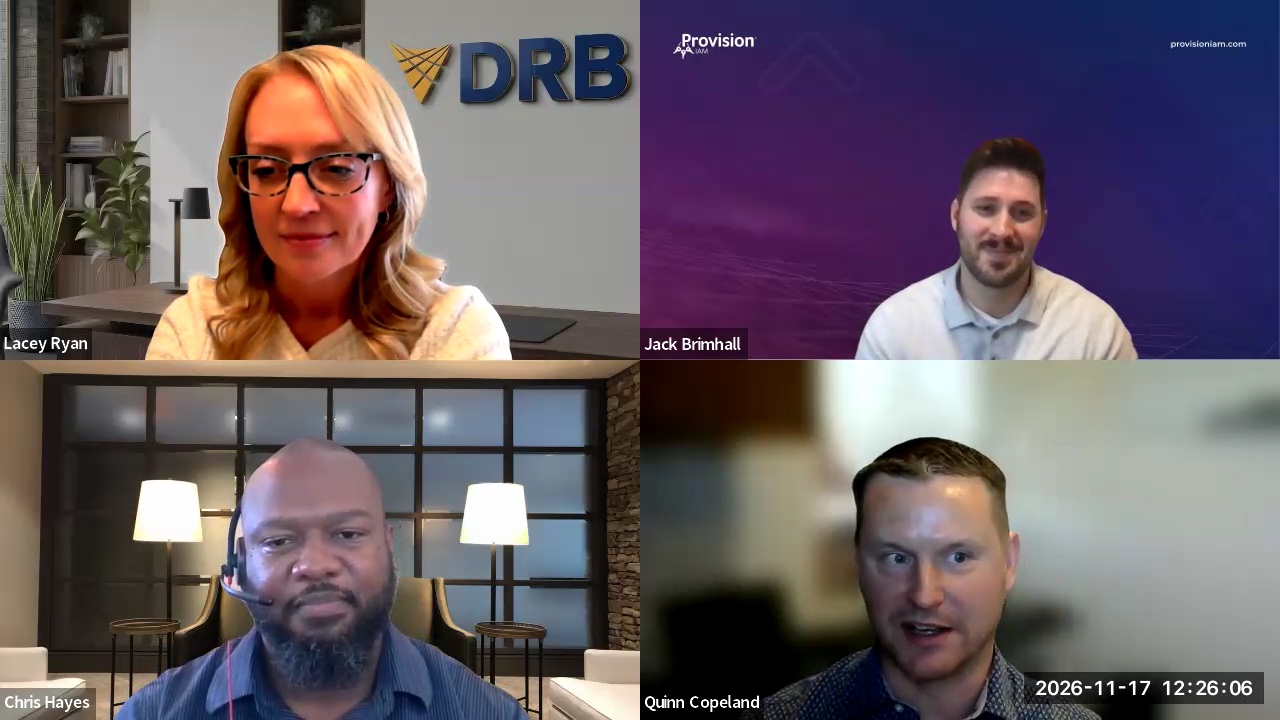
On November 17 we hosted a 45-minute live panel with technology and operations leaders from two banks and a credit union. The question in the title, who and what has the keys, ran through everything they discussed: AI governance, vendor risk, fraud, and the accounts that nobody owns.
- Lacey Ryan, Chief Information Officer, DR Bank
- Chris Hayes, Associate Managing Director and Director of Deposit Operations, Oakworth Capital Bank
- Quinn Copeland, VP of Information Technology, Park Community Credit Union
Jack Brimhall, Provision IAM’s VP of Revenue Operations, moderated. Here are the highlights, and the full recording is available at the end of this post.
What’s new on the desk
Two years ago, AI governance wasn’t on Lacey’s agenda. Now it sits near the top, and she is wary of institutions that say they simply aren’t using AI: “If you don’t think you’re using AI, your employees are.” Quinn has two laptops running AI agents in a sandbox and says the tools change so quickly that he aims to stay a step or two behind them rather than ahead. For Chris, the new item is faster payments: Oakworth has received FedNow payments for two years, added RTP this year, and is now working on originating both.
What keeps them up at night
For Lacey, it’s vendor risk. Critical systems run on vendor platforms, every vendor login and every AI feature a vendor adds is outside the bank’s control, and “those vendors also have vendors.” Due diligence, she said, can create a false sense of security. For Chris, it’s fraud. Check fraud is still rising, ACH fraud has ticked up recently, and spoofed calls still talk clients into handing over their credentials, however much the bank warns them.
Asked whether banks and credit unions face different threats, the panel agreed they don’t. In Lacey’s words, “I don’t think the attackers care about our charter type.”
It usually starts with an identity
When Chris traces a fraud case back to its start, it usually comes down to a password a client gave away on a spoofed call. Quinn added that text-message codes, the most common second factor, are also among the weakest. He also raised a newer version of the problem. If a member gives an AI agent their credentials and the agent moves money, where does liability land? He noted that Regulation E was written with a person in mind, and that blocking known agent IP ranges does nothing when the agent runs on the member’s own computer.
Inside their own institutions, all three described regular reviews:
- Chris reviews access to critical functions every six months, and Oakworth manages role-based access to 58 systems in Provision.
- Quinn now reviews every Active Directory account every six months, disabling leftovers such as accounts created for shared mailboxes and documenting what each remaining service account is for.
- Lacey takes a hard line on service accounts: “If I can’t find the owner, or if I can’t get conclusive confirmation that it is still required, I’ll disable it. You find out if it’s actually used when it’s broken.”
Where AI is showing up, and where the line is
Quinn’s team uses AI to help with lending decisions, to draft policies and job descriptions (cutting an hour of work to five minutes), and to troubleshoot errors. Lacey’s team uses it to search policy so call-center answers are faster and consistent, and for quality control: several departments now check every file instead of a sample. Her line is that AI doesn’t make decisions or take actions for the bank.
On policy, Lacey’s advice was “don’t let perfect get in the way of good enough.” DR Bank wrote an AI policy about a year ago, added AI to its acceptable-use policy, and is already rewriting much of it. Quinn described the opposite problem, where demand is high but a policy keeps getting redrafted: “The gas pedal is all the way down, the wheels are spinning, but we don’t have any traction.” For enthusiasts on staff, he recommends a sandbox kept away from production, because agentic AI “is like giving scissors to a three-year-old.” He also warned about cost: a single prompt in Microsoft’s Copilot agent tools spent $10 of credits before he noticed.
What boards want to see
Lacey’s board doesn’t want counts of orphaned or service accounts. It wants concise trends and assurance: are reviews complete, are exceptions closed, is access removed when people leave, and are there any material findings? Quinn said his examiners increasingly ask what the credit union’s own policy says and then hold it to that.
One thing to do this quarter
- Reassess (Chris). Look again at AI, fraud, payments, and staffing before the year starts, and set the foundation you want.
- Plan for a major vendor outage (Quinn). When a recent Microsoft outage affected email and Teams, the question was how to reach staff at all. Decide on a channel outside your main vendor before you need it.
- Make your actions match your words (Lacey). She once worked at a bank that wanted to appeal to younger customers but wouldn’t give up its passbook printers. Decide who you want to be, including on AI, and invest that way.
Watch the full recording
The full 44-minute panel covers more than this recap, including audience questions about how boards are responding to increased regulatory scrutiny. Fill out the form to get the recording.